
Ceramic Injection Moulding
(CIM) Flow
Complex geometry at scale with precision tolerance control. Net-shape production for demanding applications.
Get Quote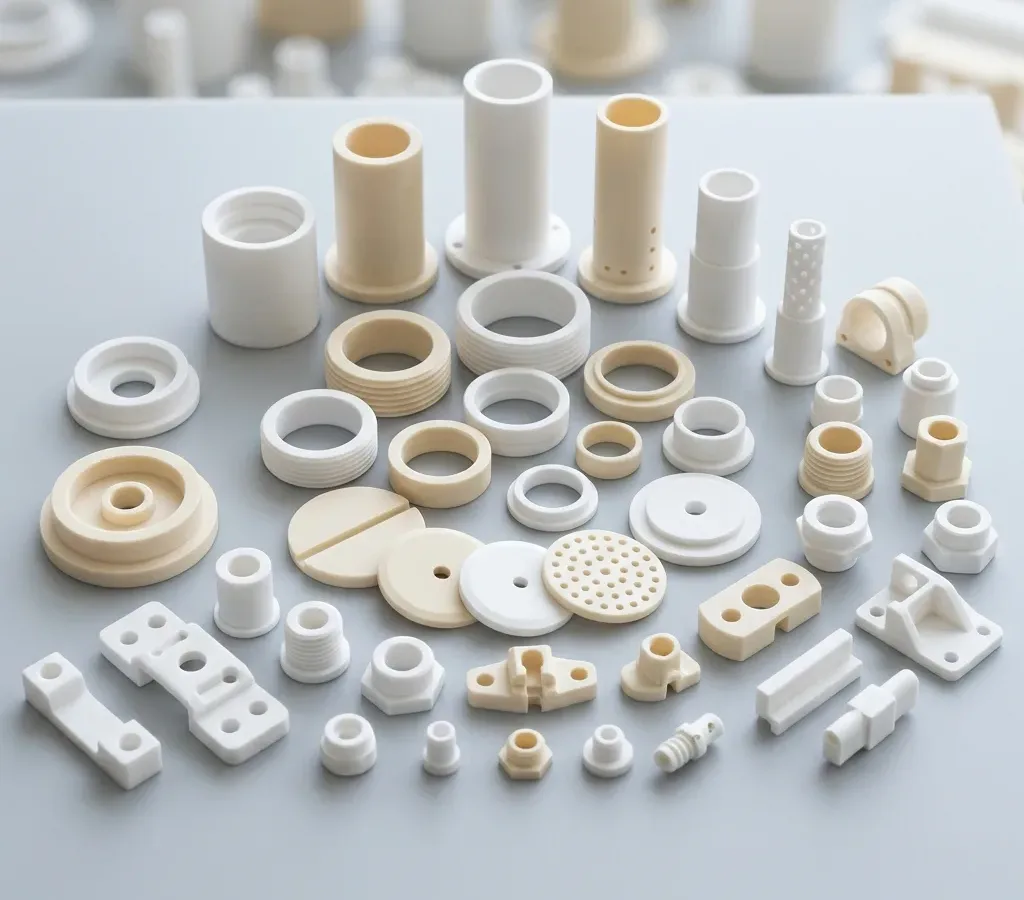
CIM Process Overview
Ceramic injection moulding follows the proven powder injection moulding framework with ceramic-specific adaptations for brittleness, shrinkage control, and surface integrity.
Powder + Binder
Ceramic powder mixed with polymer binders to create moldable feedstock.
Pellet Feedstock
Homogenized mixture formed into pellets for injection moulding.
Green Body Mold
Injection moulding creates complex-shaped green parts with binder intact.
Debind
Controlled binder removal produces porous brown body structure.
Brown Body
Intermediate state ready for sintering with precise shrinkage control.
Sinter
High-temperature densification achieves final ceramic properties.
Inspect
Dimensional verification and surface integrity assessment.
Ceramic-Specific Considerations
Brittleness Management
Ceramic materials exhibit inherent brittleness requiring careful handling during debinding and sintering phases to prevent cracking and dimensional distortion.
Surface Integrity
Surface defects can propagate as stress concentrators. Critical inspection protocols ensure surface quality meets application requirements.
Sintering Sensitivity
Precise temperature and atmosphere control during sintering prevents warping, cracking, and ensures predictable shrinkage patterns for dimensional accuracy.
When to Choose CIM
Position ceramic injection moulding around shape complexity and repeatability advantages over conventional ceramic forming methods.
Complex Geometries
Achieve intricate shapes impossible with pressing or slip casting, including undercuts, thin walls, and internal features.
High Repeatability
Consistent part-to-part dimensional accuracy for high-volume production without secondary machining operations.
Near-Net Shape
Minimize material waste and machining costs with parts requiring minimal post-processing for final dimensions.
Advanced Properties
Leverage ceramic wear resistance, corrosion resistance, and biocompatibility for demanding applications.
Cost Effectiveness
Economical for medium to high volumes where tooling costs are amortized across production runs.
Design Flexibility
Rapid prototyping and design iteration capabilities compared to traditional ceramic manufacturing methods.
Frequently Asked Questions
What is the typical shrinkage in CIM?
Ceramic parts typically shrink 15-20% during sintering. Precise shrinkage control requires careful feedstock formulation and sintering parameter optimization.
How does debinding affect part quality?
Controlled debinding prevents cracking and maintains green body integrity. Too rapid removal causes defects; too slow extends cycle time.
What tolerances can CIM achieve?
Typical tolerances range from ±0.3% to ±0.5% of nominal dimension, depending on part geometry, material system, and sintering control.
What ceramic materials work with CIM?
Alumina, zirconia, silicon nitride, and alumina-toughened zirconia are commonly processed. Material selection depends on application requirements.